When Community Support Becomes a Permit Requirement
For years, developers have treated community engagement as a part of the entitlement process. Pennsylvania has just moved it much closer to the front of the line.
Governor Josh Shapiro signed an executive order this week that establishes new requirements for data center development across the Commonwealth. One provision every developer should pay attention to is that Pennsylvania’s Department of Environmental Protection will evaluate permit applications for proposed data centers only after the developer has received local approval and made a legally binding commitment to meet the state’s Responsible Infrastructure Development (GRID) requirements.
Read that again.
Before the state environmental permitting process moves forward, the local community has to say yes.
That is a significant shift, but not because Pennsylvania suddenly invented community opposition. The shift is that the state has formally recognized what developers of controversial projects have been learning the hard way for years.
Community acceptance is no longer just a public relations objective. It is becoming a project-development requirement.
The entitlement process is moving upstream.
Development teams are accustomed to sequencing risk.
Secure the site. Confirm zoning. Study utilities. Lock down power. Complete environmental work. File the application. Then, somewhere along the way, begin talking to the community.
That sequence increasingly does not work.
Pennsylvania’s new approach effectively moves political and community viability considerations earlier in the development process. A technically sound project with available land, sufficient capital, and access to infrastructure can still stall if the local political environment cannot support it.
For data centers, that risk has become impossible to ignore.
The same executive order removes data centers from Pennsylvania’s Fast Track permitting program and bars state agencies from signing nondisclosure agreements with data center developers. The message is clear. Speed and secrecy are giving way to local approval and transparency.
Developers can debate whether that is good policy. They cannot afford to ignore what it says about the direction of the entitlement environment.
The permit isn’t the first decision anymore.
By the time a planning commission or city council formally considers a controversial project, dozens of smaller decisions have already been made.
Residents have decided whether they trust the developer.
Elected officials have decided whether supporting the project creates political risk.
Community organizations have decided whether to mobilize.
Local reporters have decided what the story is about.
Neighbors have decided whether the project represents economic opportunity or a threat to their quality of life.
Those decisions happen long before the final staff report lands on the dais.
Pennsylvania is simply putting more weight behind them.
The state’s GRID standards already require developers seeking Commonwealth support to address energy affordability, environmental protection, workforce and economic development, transparency, and community engagement. The new executive order gives those expectations greater weight by tying state environmental review to local approval.
For development teams, that changes the calculation.
A community-engagement plan cannot be something the communications team develops three weeks before a public hearing. Political due diligence has to sit alongside environmental, financial and engineering due diligence from the beginning.
Local approval has become a development asset.
Developers spend enormous amounts of time determining whether a site has the assets necessary to support a project.
Does it have power?
Does it have water?
Does it have fiber?
Can it be entitled?
There is another question that belongs on that list:
Can the project earn
permission from the community where it wants to operate?
That answer has measurable value.
A site surrounded by organized opposition, skeptical elected officials, and a history of controversial development fights carries a different risk profile than an otherwise identical site where stakeholders understand the project and local leaders have political latitude to support it.
That does not mean every community has to love a development.
It means a developer needs enough trust, credible local validators, and political support to prevent legitimate concerns from becoming an organized campaign capable of stopping the project.
The earlier that assessment happens, the more options a development team has.
You can modify a project.
You can change the benefits package.
You can address a water or power concern.
You can identify trusted community partners.
You can correct misinformation before it hardens.
You can even decide that a site carrying extraordinary political risk is not worth pursuing.
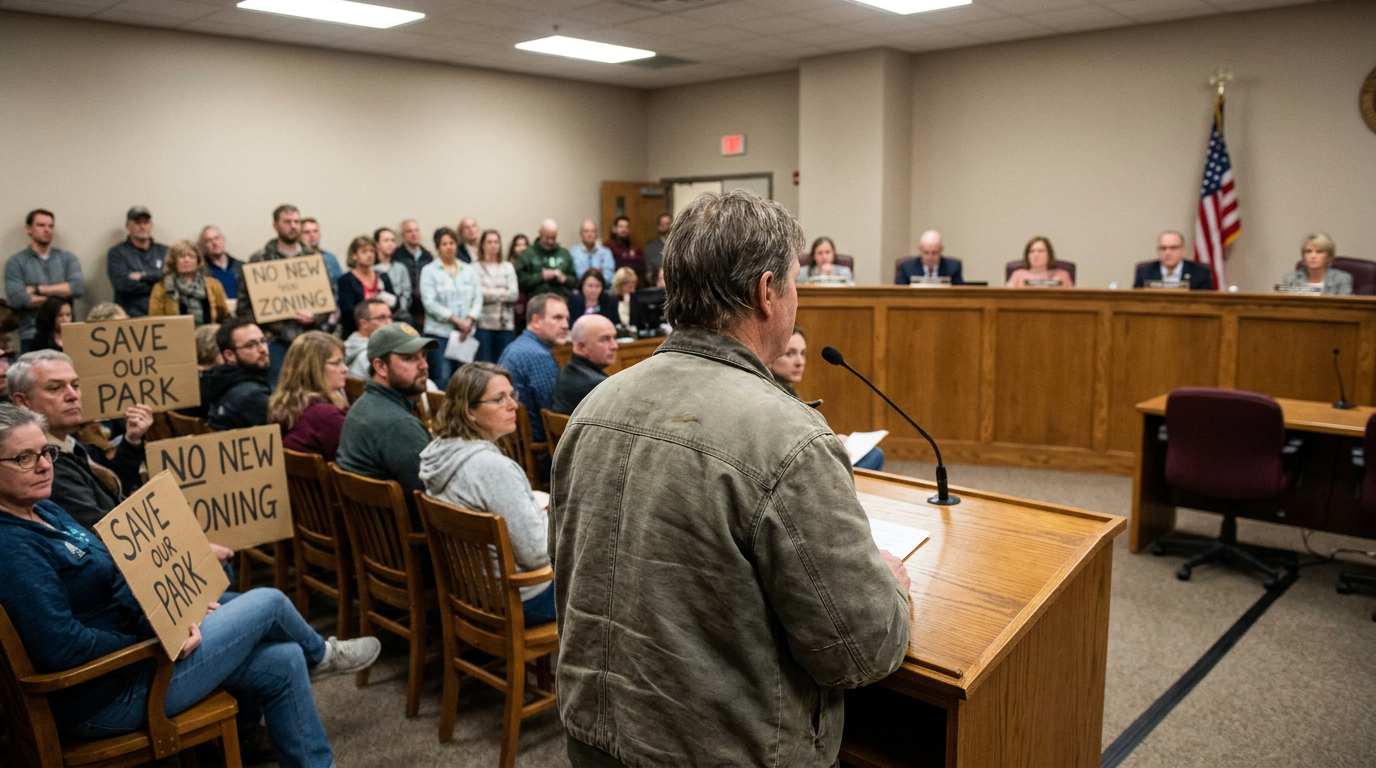
Once hundreds of residents are wearing matching shirts at a hearing, those options become much more expensive.
Transparency is becoming part of the entitlement strategy.
Pennsylvania’s prohibition on state agencies signing nondisclosure agreements with data center developers deserves just as much attention.
Data center development has relied heavily on confidentiality. Sites are assembled quietly. End users are unnamed. Project code names appear on agendas. Local officials sometimes know far more than residents.
There are legitimate business reasons for confidentiality.
Politically, however, secrecy creates a vacuum. Communities fill vacuums with suspicion.
Once residents believe something was intentionally concealed from them, the fight is no longer only about megawatts, water consumption, or tax revenue. It becomes a fight about trust.
That is a much harder argument for a developer to win.
Transparency does not mean releasing every confidential business detail. It means identifying early what the public reasonably needs to know and communicating it before opponents define the project for you.
How much water will it use?
Who pays for electrical upgrades?
What happens to residential utility rates?
What will residents actually receive in return?
How will noise, emissions and construction impacts be handled?
Those questions are coming whether the developer answers them proactively or not.
Pennsylvania won’t be the last.
The larger lesson extends far beyond data centers and far beyond Pennsylvania.
Housing projects face organized neighborhood opposition. Renewable-energy projects encounter local resistance to transmission infrastructure. Logistics facilities trigger truck-traffic campaigns. Industrial projects face environmental concerns. Large master-planned communities can spend years navigating questions about schools, roads, and water.
The particular issue changes.
The political dynamic does not.
Communities are increasingly organized, information travels faster, elected officials are more sensitive to land-use controversies, and governments are finding new ways to incorporate local concerns into development rules.
Pennsylvania has simply made the relationship unusually explicit.
A project can meet the technical requirements and still need to earn the community’s permission before the regulatory process moves ahead.
For developers, the takeaway should not be that Pennsylvania has made development impossible.
It’s now the case that the community strategy is part of the development strategy.
Teams that understand this before selecting a site, announcing a project, or filing an application will have an enormous advantage over those that discover it at the hearing.
At Land Use Strategies, we work with development teams before the entitlement process becomes a political fight. We evaluate local political conditions, identify potential opposition, engage stakeholders, build community coalitions, and create the support decision-makers need to move projects forward. If you’re considering a project in a community where local sentiment could determine its viability, that work should begin long before the application is filed.
Recent Posts